Bid Made to Increase Height of Historic Golden Mile Building
Plan submitted to add extra storey to Art Deco Westlink House

Westlink House on the Great West Road. Picture: History of Brentford
February 10, 2026
Plans have been submitted to add a new upper floor to Westlink House, the Grade II listed Art Deco landmark on the Great West Road, which is of one of Brentford’s most historically significant industrial buildings.
The proposal (P/2026/0181) seeks permission for a lightweight glazed storey set back from the main façade of the former Pyrene fire extinguisher factory at 981 Great West Road. The new floor would provide flexible serviced office space, meeting rooms, a cafeteria and small studio facilities for filming, broadcasting and digital production.
Westlink House, originally known as the Pyrene II Factory, was designed in 1928–30 by Wallis, Gilbert & Partners, the architects responsible for many of the Great West Road’s most celebrated interwar industrial buildings. The attached heritage assessment describes the building as “an iconic structure that not only served its industrial purpose but also became a symbol of modernity and progress in the area.”
The building’s central tower, stepped parapets and strong horizontal wings exemplify the streamlined Modernistic style that defined the Golden Mile. According to the listing description reproduced in the assessment, its “striking central tower with stepped haunches and abstract moulded decoration” and symmetrical façade remain key elements of its architectural significance.
Despite its prominence, Westlink House has suffered from years of underuse and gradual deterioration. The heritage report notes that the building is on Historic England’s “at risk” register, and that later extensions and internal alterations have diluted some of its original clarity. The assessment also highlights that “many of the play features… are coming to the end of their practical life and need replacing”.
The applicant argues that the decline of traditional office demand, accelerated by the pandemic, has left the building struggling to attract tenants. While internal adaptations have allowed a mix of Class E uses to continue, the heritage statement claims that securing a viable long-term use is essential to prevent further deterioration.
The proposed new floor has been deliberately set back from the parapet and designed in glass to ensure the original Art Deco composition remains visually dominant. Pre-application discussions with Hounslow Council advised that any extension must respect the building’s strong geometric form while remaining clearly contemporary.
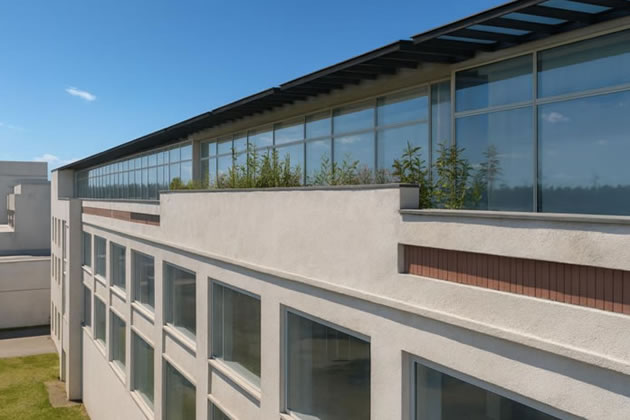
A visualisation of the extra floor from the planning submission
The heritage assessment emphasises that the most significant elements of the 1930s structure — including the central tower, original façade line and surviving sections of the early factory — must be preserved. A building age plan included in the document identifies the frontage as the area of highest significance, while later additions to the rear and east are considered less sensitive.
One section of original 1930s walling survives within a later extension, described in the report as “a tangible link to the building’s past,” and the design team says this will be retained.
The site sits within Strategic Industrial Land (SIL), where London-wide and local planning policy strongly protects industrial and logistics uses. While Westlink House has long operated in an office-style capacity, the council continues to seek industrial capacity in the Great West Corridor, particularly for creative production.
The applicant argues that the physical constraints of the listed structure — including its narrow floorplates, historic façade and limited loading capacity — make modern industrial use impractical without causing unacceptable harm to its heritage value. Instead, they propose that small studios and flexible workspace could support nearby film, media and digital industries, complementing the area’s emerging creative cluster.
From a conservation perspective, the scheme argues that securing a viable use for a listed building at risk constitutes a public benefit. The heritage assessment stresses that “a robust Statement of Significance is the cornerstone of any heritage-led development proposal,” and that sensitive adaptation is essential to ensure the building’s continued relevance.
National planning policy allows “less than substantial harm” to listed buildings where outweighed by public benefits. The applicant maintains that the lightweight roof extension would cause minimal impact while enabling investment in maintenance and restoration.
The proposal comes amid significant redevelopment along the Great West Road, where former industrial sites are being repurposed for mixed commercial, creative and residential uses. The heritage report situates Westlink House within this broader trend, noting its role as part of a once-continuous corridor of Art Deco factories including the Firestone Building, Coty, Gillette and Packard Cars.
Hounslow Council will now assess the application against heritage policy, industrial land protections and design standards. Local reaction is expected to focus on the balance between safeguarding the Golden Mile’s industrial role and finding viable new uses for historic buildings that no longer suit traditional manufacturing.
The application, reference P/2026/0181, is open for public comment until the first week of March . The council’s planning portal will be unavailable for scheduled maintenance between 11 and 12 February. Once the consultation period closes, planning officers will assess the proposal before it is considered by councillors at a future planning committee meeting.
Like Reading Articles Like This? Help Us Produce More This site remains committed to providing local community news and public interest journalism. Articles such as the one above are integral to what we do. We aim to feature as much as possible on local societies, charities based in the area, fundraising efforts by residents, community-based initiatives and even helping people find missing pets. We’ve always done that and won’t be changing, in fact we’d like to do more. However, the readership that these stories generates is often below that needed to cover the cost of producing them. Our financial resources are limited and the local media environment is intensely competitive so there is a constraint on what we can do. We are therefore asking our readers to consider offering financial support to these efforts. Any money given will help support community and public interest news and the expansion of our coverage in this area. A suggested monthly payment is £8 but we would be grateful for any amount for instance if you think this site offers the equivalent value of a subscription to a daily printed newspaper you may wish to consider £20 per month. If neither of these amounts is suitable for you then contact info@neighbournet.com and we can set up an alternative. All payments are made through a secure web site. One-off donations are also appreciated. Choose The Amount You Wish To Contribute. If you do support us in this way we’d be interested to hear what kind of articles you would like to see more of on the site – send your suggestions to the editor. For businesses we offer the chance to be a corporate sponsor of community content on the site. For £30 plus VAT per month you will be the designated sponsor of at least one article a month with your logo appearing if supplied. If there is a specific community group or initiative you’d like to support we can make sure your sponsorship is featured on related content for a one off payment of £50 plus VAT. All payments are made through a secure web site. |