TfL Reveals Details of Proposals for Cycleway 9 West
Consulting residents on segregated route from Syon Park to Hounslow
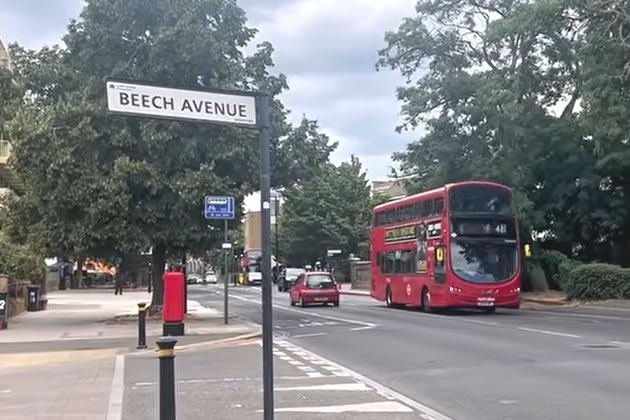
The new cycleway would commence in the east at Beech Avenue
September 8, 2026
Transport for London (TfL) has published its long-awaited proposals to extend Cycleway 9 westwards from Syon Park to Hounslow Town Centre, setting out a package of changes to London Road and the High Street that would reshape one of west London’s busiest corridors for people walking, cycling and using public transport. The six-week consultation, marks a significant step forward in the project and one that is likely to attract strong views from residents, businesses and transport users.
The plans would introduce continuous segregated cycle tracks, upgraded pedestrian crossings, redesigned side-road junctions, widened footways and new infrastructure. TfL says the scheme aims to make the route safer, more accessible and more attractive for active travel, while improving connections between Brentford, Isleworth and Hounslow. The proposals follow earlier works east of Beech Avenue, where Hounslow Council has already delivered a section of the Brentford–Hounslow route previously consulted on. However, the cycleway is currently interrupted at Alexandra Road east of Brentford centre and the report from the consultation on the route between that point and Beech Avenue is yet to be published.
The consultation papers do not mention this gap in provision and we have asked TfL if Cycleway 9 West is contingent on the section through Brentford being completed or if it will be progressed regardless.
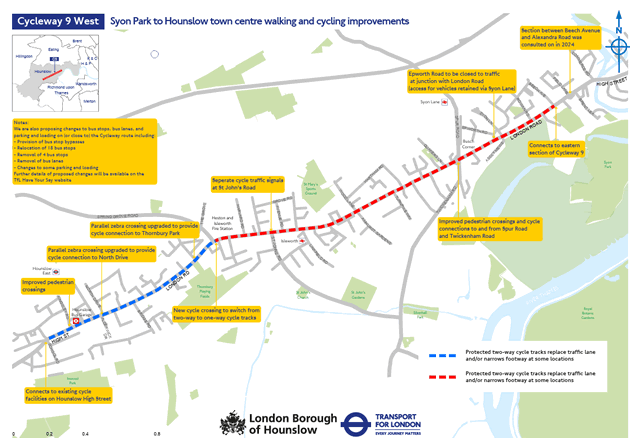
The map of the proposed route
Across the full length of the Syon Park–Hounslow corridor, TfL is proposing:
- New segregated cycle tracks on both sides of London Road, with a two-way track introduced west of Sidmouth Avenue.
- Side-road entry treatments — raised junctions designed to slow turning vehicles and give pedestrians a level surface to cross.
- Upgraded crossings, including new parallel crossings for pedestrians and cyclists, widened zebra crossings, and new signal-controlled crossings outside shops and colleges.
- Bus stop bypasses at numerous locations, allowing cyclists to pass behind waiting passengers, with “mini zebra crossings” to help people reach bus stops safely.
- Changes to bus infrastructure, including the relocation of 18 bus stops and removal of four.
- Parking and loading changes, including removals in some areas and increases in others.
- Tree removal and replacement, with TfL stating it will 'seek opportunities' to provide replacement trees in nearby locations.
The proposals are broken into detailed sections, from Beech Avenue to Busch Corner, Busch Corner to Langley Road, St John’s Road to Spring Grove, Spring Grove to Honnor Gardens, Star Road to Richens Close, and Alderwick Drive to Kingsley Road, continuing through the High Street to the School Road/Laurence Road junction. Each section includes specific interventions — from closing the Epworth Road junction to motor traffic, to widening pedestrian islands, to simplifying the Kingsley Road junction with larger crossing areas.
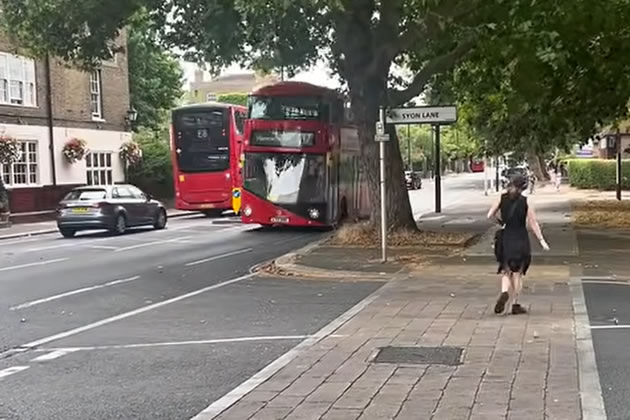
TfL says that peak time delays to traffic would increase, including for buses
Cycleway 9 is one of TfL’s flagship protected cycle routes, originally conceived to link Hammersmith, Chiswick, Kew Bridge and Brentford. The eastern sections — including Chiswick High Road and the Kew Bridge–Watermans Park stretch — are already complete. Hounslow Council has also delivered improvements between Watermans Park and Alexandra Road.
The Syon Park–Hounslow Town Centre extension represents the final western phase, potentially creating a continuous protected route from Hammersmith to Hounslow. It is also designed to connect with future links to Cycleway 40 (Old Isleworth–Twickenham), forming a broader west London cycling network.
TfL’s modelling suggests some increases in peak-time traffic delays. For general traffic these are expected to increase by up to 2 minutes eastbound and 3 minutes westbound. Buses could see journey times rise by 100 second westbound and less than a minute eastbound. TfL cautions that “actual journey times may differ from the modelled results because traffic conditions vary from day to day.”
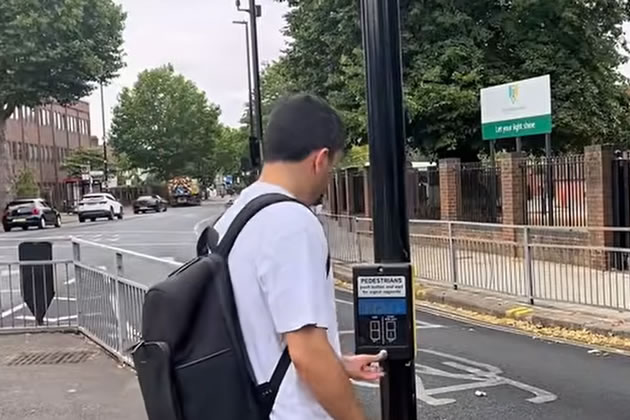
Crossing such as the one by the Green School would be upgraded
While many residents may welcome safer crossings and better cycling infrastructure, several aspects of the proposals are likely to generate controversy.
TfL plans to relocate 18 bus stops and remove four entirely, including the eastbound stop at Beech Avenue and bus stop J near Star Road. The removal of the westbound Bridge Road bus stop — with spacing between remaining stops increasing to around 500 metres — may be contentious for passengers with mobility issues or those reliant on frequent local stops.
The scheme includes the removal of bus lanes at certain points, which may raise concerns about bus reliability, especially given the predicted increases in journey times.
Several parking bays would be removed — including six spaces outside Warren Motors in Isleworth— while others would be increased or repositioned. Businesses along London Road and the High Street may question the impact on deliveries, customer access and footfall.
TfL acknowledges that “some trees will need to be removed” to accommodate the cycle tracks. Although replacement planting is promised, tree loss is often a flashpoint in local consultations, particularly in areas with limited existing canopy cover.
The closure of the Epworth Road junction to motor traffic, and the removal of traffic islands at Amhurst Gardens and Bridge Road, may prompt concerns about vehicle access, turning movements and neighbourhood traffic patterns.
Two-way tracks can be divisive: supporters welcome their clarity and protection, while critics worry about conflicts at side roads and crossings, particularly where visibility is limited. Emerging evidence from the eastern section of the cycleway is that serious collisions involving cyclists have increased on bi-directional sections but TfL is taking steps to mitigate this problem.
TfL is holding two drop-in events at West Thames College — on 23 September and 10 October — where residents can speak directly with TfL staff. Feedback can be submitted online, by email, by phone or by post.
The consultation will inform TfL’s final designs and decisions on whether to proceed. As with all major transport schemes, residents are encouraged to review the detailed maps and proposals before responding.
TfL has set up a Cycleway 9 West consultation web page where you can see detailed maps and get more information on the scheme as well as give your views on the proposal.
Residents now have until 19 October to make their voices heard.
Like Reading Articles Like This? Help Us Produce More This site remains committed to providing local community news and public interest journalism. Articles such as the one above are integral to what we do. We aim to feature as much as possible on local societies, charities based in the area, fundraising efforts by residents, community-based initiatives and even helping people find missing pets. We’ve always done that and won’t be changing, in fact we’d like to do more. However, the readership that these stories generates is often below that needed to cover the cost of producing them. Our financial resources are limited and the local media environment is intensely competitive so there is a constraint on what we can do. We are therefore asking our readers to consider offering financial support to these efforts. Any money given will help support community and public interest news and the expansion of our coverage in this area. A suggested monthly payment is £8 but we would be grateful for any amount for instance if you think this site offers the equivalent value of a subscription to a daily printed newspaper you may wish to consider £20 per month. If neither of these amounts is suitable for you then contact info@neighbournet.com and we can set up an alternative. All payments are made through a secure web site. One-off donations are also appreciated. Choose The Amount You Wish To Contribute. If you do support us in this way we’d be interested to hear what kind of articles you would like to see more of on the site – send your suggestions to the editor. For businesses we offer the chance to be a corporate sponsor of community content on the site. For £30 plus VAT per month you will be the designated sponsor of at least one article a month with your logo appearing if supplied. If there is a specific community group or initiative you’d like to support we can make sure your sponsorship is featured on related content for a one off payment of £50 plus VAT. All payments are made through a secure web site. |