Hounslow Council Defends Response to Cold Snap
Residents report falls on icy streets and pavements
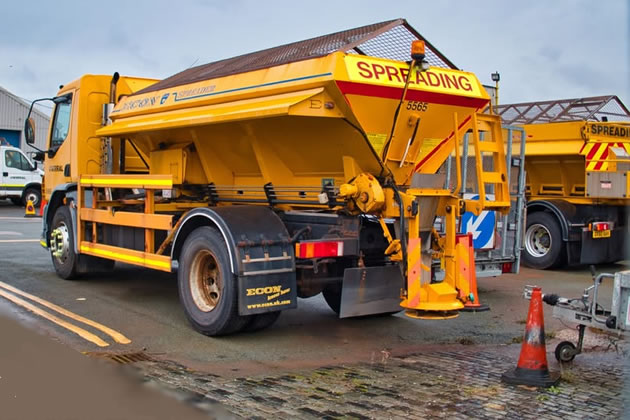
The council's gritting lorries cover less than a third of the borough's road network. Picture: Hounslow Council
January 8, 2026
Hounslow Council has defended its winter service operations after residents reported dangerous icy conditions during the recent cold snap, including several falls and injuries.
Conservative councillor Joanna Biddolph said she had been contacted by residents who described pavements as “treacherous,” with two young women reportedly suffering head injuries and an elderly neighbour falling on their way to the station. One resident told her that people were slipping on the bridge near the station and that a motorcyclist had skidded on Chiswick High Road. Cllr Biddolph argued that the cold weather had been forecast well in advance and accused the council of failing in its duty of care. She also questioned whether Hounslow had enough gritting vehicles and whether the borough was “at the back of the queue” for winter service resources.
In response, Hounslow Council and Hounslow Highways said the borough had been operating its winter service in line with its established Winter Policy, with 24‑hour monitoring in place from mid‑November to March. The council said there had been four precautionary grit runs since New Year’s Day, with major strategic and principal routes — including Chiswick High Road, London Road, Bath Road and Staines Road — most recently gritted from 7pm on Thursday. Councillor Shivraj Grewal, Cabinet Member for Infrastructure, Recycling and Transformation, said public safety remained the council’s priority and that officers were continuing to monitor conditions closely as the weather changed.
Hounslow Highways explained that throughout the winter it operates six gritting vehicles, each spreading rock salt across the borough’s road network. At the beginning of the season, 1,200 tonnes of salt are stored at Ashmead Depot, and supplies are replenished as the season progresses. The organisation said it cannot grit every road in the borough because of the time and cost involved. Instead, it focuses on principal roads, classified roads, important access routes and selected bus routes, with the network designed to ensure that critical locations such as hospitals, fire stations and police stations remain accessible. Although Hounslow has 268 miles of road, the standard gritting network covers 82 miles.
Gritting usually takes place late at night or in the early hours of the morning so that roads are treated before ice forms, and crews try to avoid gritting during rush hour to minimise disruption. Some major roads in the borough, including the A4, A30, A406, A205, A312 and A316, are managed by Transport for London rather than Hounslow Highways, while the M4 and M25 are treated by National Highways.
The decision to grit is based on forecasts from a specialist winter weather bureau, which provides updates four times a day predicting freezing road temperatures, snow and the likely timing of hazardous conditions. A 24/7 duty rota ensures that staff can respond quickly. The schedule of treated roads is reviewed annually, and requests for additional roads can only be considered at the end of the winter season, not during it.
Hounslow Highways also addressed concerns about pavements, which were a particular issue for residents near Gunnersbury station. The organisation said widespread footway gritting is not feasible because the borough has nearly 500 miles of pavements. Instead, pavements are gritted only in specific locations such as bus stops, tube stations and the main entrances to schools and hospitals. Footway gritting is labour‑intensive and cannot be carried out quickly enough when frost is expected to melt naturally within a short period. Only when persistent snow appears does the borough attempt more extensive pavement gritting. During the recent cold spell, Hounslow Highways said it had been manually spot‑gritting town centres and areas around transport hubs in response to localised icy patches caused by high moisture levels and freezing overnight temperatures.
The organisation added that it does not provide grit bins or supply salt to individuals, although residents can purchase rock salt from local hardware stores. It also noted that when snow is forecast, salt is spread to slow the rate at which snow settles, but heavy snowfall can overwhelm the salt’s effectiveness. Snow ploughs are not practical in a built‑up area like Hounslow because of traffic, parked cars and the lack of space to push snow aside.
Despite the detailed explanation, some residents remain concerned that the response did not match the severity of the conditions they experienced. Cllr Biddolph said she would continue pressing for improvements, particularly around stations and busy pedestrian routes. The cold spell is expected to ease as milder weather moves in, but both councillors and officers indicated that lessons from this week’s conditions will be reviewed as part of the end‑of‑season assessment.
Like Reading Articles Like This? Help Us Produce More This site remains committed to providing local community news and public interest journalism. Articles such as the one above are integral to what we do. We aim to feature as much as possible on local societies, charities based in the area, fundraising efforts by residents, community-based initiatives and even helping people find missing pets. We've always done that and won't be changing, in fact we'd like to do more. However, the readership that these stories generates is often below that needed to cover the cost of producing them. Our financial resources are limited and the local media environment is intensely competitive so there is a constraint on what we can do. We are therefore asking our readers to consider offering financial support to these efforts. Any money given will help support community and public interest news and the expansion of our coverage in this area. A suggested monthly payment is £8 but we would be grateful for any amount for instance if you think this site offers the equivalent value of a subscription to a daily printed newspaper you may wish to consider £20 per month. If neither of these amounts is suitable for you then contact info@neighbournet.com and we can set up an alternative. All payments are made through a secure web site. One-off donations are also appreciated. Choose The Amount You Wish To Contribute. If you do support us in this way we'd be interested to hear what kind of articles you would like to see more of on the site – send your suggestions to the editor. For businesses we offer the chance to be a corporate sponsor of community content on the site. For £30 plus VAT per month you will be the designated sponsor of at least one article a month with your logo appearing if supplied. If there is a specific community group or initiative you'd like to support we can make sure your sponsorship is featured on related content for a one off payment of £50 plus VAT. All payments are made through a secure web site. |